Contents
Gengar has appeared across almost every era of the Pokémon TCG, from a Fossil holo to Gengar Prime, Mega Gengar EX, Gengar VMAX alternate art and the current Mega Gengar ex attention. Below are the real cards Grade Hunter tracks, with current raw, PSA 9 and PSA 10 market estimates and the profit left after grading and selling costs.
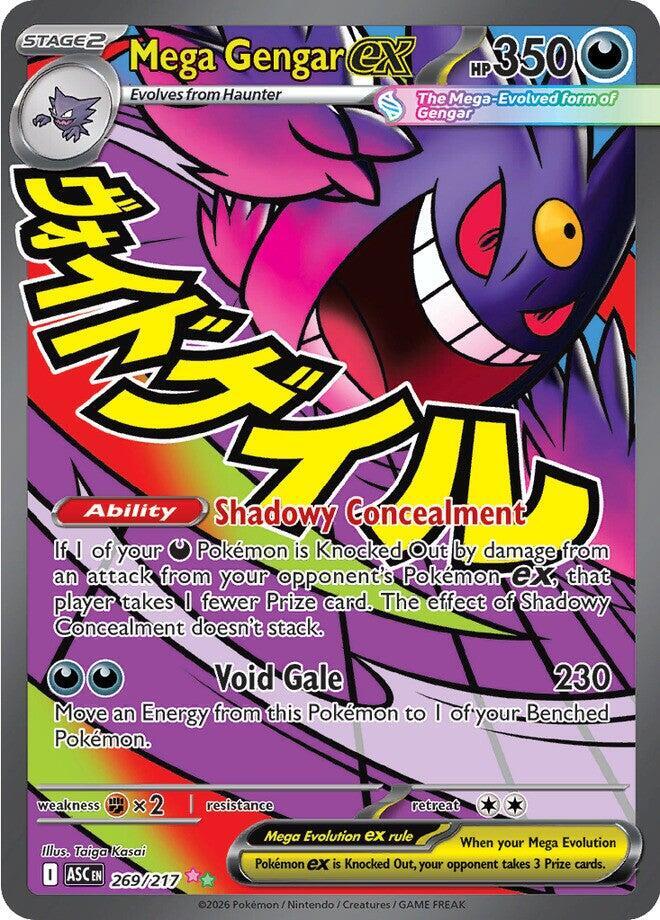
Gengar is one of a small handful of Pokémon that collectors chase across every era of the trading card game. It is National Pokédex #094, the final form of the Gastly → Haunter → Gengar line, and it has been printed and reprinted from the Wizards of the Coast years right through to the current Mega era. That long run is exactly why Gengar card values are so uneven: two cards can share the same Pokémon, the same purple grin and almost the same artwork idea, and be worth two hundred dollars apart.
This guide covers the Gengar cards that matter to collectors, what makes them collectible, and — using Grade Hunter's tracked market data — what they currently sell for raw and in a PSA 10. Every price on this page is a live market estimate pulled from the same database that powers the rest of the site, with the snapshot date visible so you always know how fresh it is.
At a glance: what makes Gengar cards collectible
- Character popularity. Gengar has been a top-tier fan favourite since 1996, which keeps demand steady even when the competitive format ignores it.
- Distinctive dark artwork. Gengar cards lean into purple, black and shadow, which makes them stand out in a binder and photograph well in a slab.
- Representation across eras. There are collectable Gengar cards from the Fossil era, the e-Card era, the Lv.X era, Primes, EX/Mega, GX Tag Teams, VMAX and the current Mega era.
- Scarcity of gem-mint copies. Older Gengar holos have dark borders and glossy holo panels — the two features that show wear soonest. Plenty of raw copies exist; clean ones do not.
Gengar card values: quick market view
This is the live picture from Grade Hunter's tracked Gengar records. It counts how many Gengar cards we hold graded data for, how many currently show a positive estimated profit after costs, and which card carries the highest tracked PSA 10 estimate.
A brief history of Gengar in the Pokémon TCG
Gengar's English card history starts with the Fossil holo in 1999. It was one of the set's marquee holos, and because it was played and traded heavily, it now sits in an awkward place: easy to find raw, difficult to find clean. That pattern repeats across almost every vintage Gengar.
The Wizards-era run continued through Gym-set Trainer cards and the darker Team Rocket treatments, then into the e-Card sets. Skyridge, printed at the end of the Wizards licence, is the scarcest of these. Fewer copies entered the market to begin with, and the ones that did were often opened by collectors who did not expect grading to become a market.
The mid-2000s brought Gengar into the EX era, where holo patterns changed and surface scratching became the main condition risk. Then came the mechanic-defined chase cards that shaped modern Gengar collecting: Gengar Lv.X in the Platinum-adjacent Arceus set, and Gengar Prime in Triumphant. Both are era-defining and both are notoriously hard to grade well, because the foil covers the whole card face and the dark borders reveal any whitening instantly.
From 2014 onward, Gengar shifted into the full-art era. Gengar-EX and M Gengar-EX in Phantom Forces made Mega Gengar a collector target. Gengar & Mimikyu-GX in Team Up paired two fan favourites on one card and held value long after rotation. In 2021, Fusion Strike delivered the Gengar VMAX alternate art secret rare — the card most people now mean when they say "the expensive modern Gengar". Lost Origin's Trainer Gallery added a cheaper way into modern Gengar art, and the 2026 Mega era has brought Mega Gengar ex attention back to the whole line.
The Gengar TCG timeline, era by era
Scroll across to see how Gengar's collector story moves through the game's eras. Card images come from Grade Hunter's tracked records.
- 1999
Fossil Gengar
Gengar's first English holo. Condition-sensitive and still the vintage benchmark.
- 2002–03
e-Card era (Skyridge)
Late Wizards-era printing with very few high-grade survivors.
- 2009
Gengar Lv.X (Arceus)
A Lv.X chase card with one of the widest tracked raw-to-PSA-10 gaps.
- 2010
Gengar Prime (Triumphant)
The Prime mechanic's most collected Gengar, with heavy edge-wear risk.
- 2014
Gengar-EX / M Gengar-EX
Phantom Forces put Mega Gengar into the modern collector conversation.
- 2019
Gengar & Mimikyu-GX
A Tag Team card that stayed collected long after it left the format.
- 2021
Gengar VMAX alternate art
Fusion Strike's secret alternate art — the modern Gengar most people mean.
- 2022
Gengar V Trainer Gallery
Lost Origin's Trainer Gallery print, a cheaper route into modern Gengar art.
- 2026
Mega Gengar ex
Mega-era attention has pulled fresh volume back to every older Gengar.
10 Gengar cards every collector should know
Each card below is matched to a real tracked record, so the set name, card number and prices update with the market rather than sitting frozen in an article. Prices are current market estimates, not guaranteed sale prices.
Tracked Gengar records are unavailable right now — search Gengar cards for live data.
All Gengar Cards Tracked by Grade Hunter
This is the full list of Gengar cards with tracked pricing, including estimated net profit and ROI after grading and selling costs. Sort it by value, profit, ROI or raw price, and filter down to vintage, modern or only the cards that currently show a positive estimated return.
Which Gengar cards may be worth grading?
A Gengar card is a plausible grading candidate when four things are true at once. It has a meaningful gap between raw and PSA 10 value. It has enough graded sales history that the PSA 10 number is not resting on one lucky auction. The PSA 9 outcome is at least close to break-even, so a good-not-perfect grade does not put you underwater. And your specific copy actually looks like a 10 candidate under close inspection.
Cards that fail the second test are the most common trap in Gengar data. Several scarce vintage and Lv.X-era Gengars show enormous spreads precisely because almost nobody sells them, which makes the estimate volatile rather than reliable. We flag those as thin comps rather than dressing them up as certainty. For the general framework, our guide to the best Pokémon cards to grade walks through the same criteria applied across the whole database.
Raw vs PSA 10: how to read the spread
There are three different prices in play, and confusing them is how people lose money. The raw market value is what ungraded copies sell for, averaged across every condition from near-mint to well-loved. The PSA 9 value is what a verified mint-but-not-perfect copy sells for. The PSA 10 value is what a verified near-flawless copy sells for, and it applies to a small minority of copies.
Net profit, in plain language, is the graded sale price minus the marketplace fees you pay to sell it, minus what you paid for the raw card, minus the grading cost, minus any shipping, insurance or other costs. Grade Hunter uses that single formula everywhere on the site, with your own saved assumptions, which is why the profit figures here will not match a simple "PSA 10 price divided by raw price" percentage. If you want to change the inputs and watch the outcome move, use the Pokémon card grading calculator.
Grader choice affects the same maths. PSA usually realises the highest Pokémon resale prices, but not always by enough to justify its cost on lower-value cards — we compare the trade-offs in PSA vs CGC vs BGS.
Why PSA 9 matters more than most collectors think
Most submissions do not come back as 10s. That is not pessimism, it is the base rate, and it is especially true for dark-bordered vintage Gengar holos where a single edge nick caps the grade. So the honest way to evaluate a submission is to ask what happens if the card grades 9 — because that is the more likely outcome on any card you are not certain about.
If the PSA 9 outcome is a heavy loss and the PSA 10 outcome is the only thing making the submission work, you are not investing, you are buying a lottery ticket with a fixed entry fee. Cards where both grades clear costs are rarer and much better.
How to inspect a raw Gengar card before grading
Older holo Gengars are condition-sensitive in specific, predictable ways. Work through them in order:
- Surface scratches and holo wear. Tilt the card under a single light source. Fine scratches on the holo panel are invisible face-on and obvious at an angle.
- Edge whitening. Dark borders on Fossil, Prime and Lv.X-era Gengars show white flecks immediately. Check all four edges against a dark background.
- Corners. Look for softness and fraying rather than obvious damage. A slightly rounded corner is enough to cap a grade.
- Print lines and dents. Print lines run across the holo in a straight line and are a factory defect you cannot fix. Dents show as a shadow when the card is rotated.
- Centering. Compare the border widths left-to-right and top-to-bottom. Full-art Mega and VMAX cards are frequently off-centre.
If you are buying raw specifically to grade, our guide to buying raw cards for grading covers how to read listing photos and which sellers to avoid.
Best Gengar cards by collector type
Vintage collectors
The Fossil holo is the anchor purchase, and the Skyridge holo is the scarcity play if you can find one with credible condition photos. Expect to pay for condition rather than hoping to upgrade it later.
Modern collectors
The Fusion Strike Gengar VMAX alternate art is the modern centrepiece, with Mega Gengar ex representing the current era. Both have deep enough markets that you can buy and sell without waiting months.
Budget collectors
Diamond & Pearl and mid-era Gengar holos, the regular Fusion Strike Gengar VMAX and the Lost Origin Trainer Gallery print give you real Gengar artwork at a fraction of the chase-card price.
Display collectors
M Gengar-EX, Gengar & Mimikyu-GX and the VMAX alternate art are the cards that look best in a slab on a shelf. Artwork scale matters more than rarity here.
Grading-upside hunters
Use the sorted list above with the "Positive estimated profit" filter, then verify the top results against recent completed sales. The Grade Hunter leaderboard applies the same logic across every tracked card, not just Gengar.
Common Gengar variants and identification mistakes
Most valuation mistakes with Gengar are identification mistakes. The same set can contain a holo and a non-holo Gengar with very different values, and modern sets often hold a regular version, a full-art or alternate-art version and a secret-rare numbering above the set total. Promo, prerelease and Prize Pack prints add another layer: they can share artwork and even a card number with a mainline print while trading completely differently.
The fix is simple. Match the set name and the card number printed on your copy — a format like 20/62, 94/102, 157/264 or TG06/TG30 — before you compare any price. Grade Hunter lists both for every tracked card so you can confirm you are looking at the right one, and card numbers above the set total (271/264, for example) indicate a secret rare rather than the regular print.
Gengar card value FAQ
- What is the most valuable Gengar Pokémon card?
- There is no single permanent answer, because graded prices move with each sale. Among the most valuable tracked Gengar cards in Grade Hunter's data are Gengar Lv.X from Arceus, Gengar Prime from Triumphant and the Skyridge holo, all of which carry very high graded estimates supported by relatively few sales. Check the live tracked list before treating any of them as a fixed number.
- Which Gengar cards are rare?
- Scarcity comes from two things: how few copies were printed, and how few survive in high grade. Wizards-era prints such as the Skyridge holo are scarce on both counts. Modern cards like the Fusion Strike Gengar VMAX alternate art were printed in far larger numbers but still trade high because demand is deep and gem-mint copies are a small share of the total.
- Are Gengar cards worth grading?
- Some are, most are not. A submission only makes sense when the graded sale price clears your raw cost, the grading fee, any shipping or insurance and the marketplace commission, with enough margin left to survive a PSA 9 instead of a PSA 10. Grade Hunter shows that calculation per card so you are not guessing.
- How much is a Gengar PSA 10 worth?
- It depends entirely on which Gengar. Tracked PSA 10 estimates in Grade Hunter's Gengar data span from a couple of hundred dollars for common modern prints to five figures for the scarcest vintage and Lv.X-era cards. Always read the specific set name and card number, not just the Pokémon.
- Is Gengar VMAX worth grading?
- The regular Fusion Strike Gengar VMAX has a modest spread, so grading it usually only works if you buy the raw copy well. The alternate art secret print has much higher graded value, but its raw price is already high — which means a PSA 9 result can remove most of the margin. Run the numbers on the exact print you own.
- What should I check before buying a raw Gengar card?
- Centering, corner sharpness, edge whitening, holo scratches, print lines and any surface dents, using angled photos rather than flat scans. On older Gengar holos, surface wear is the most common reason a card grades 9 instead of 10.
- Why is the PSA 10 price so much higher than raw?
- A PSA 10 price reflects a card that has been verified as near-flawless, which is a small fraction of copies in circulation. The raw price is an average across all conditions. The gap between the two is a measure of how hard the top grade is to achieve, not a discount waiting to be collected.
- How do I identify which Gengar card I own?
- Use the card number and the set symbol, not the artwork. The number is printed in the lower corner in a format such as 20/62 or 271/264, and Grade Hunter lists both the set name and number for every tracked card so you can match your copy exactly.
Methodology and sources
- Card identities, set names, card numbers and images come from Grade Hunter's tracked Pokémon card database.
- Raw and graded values are current tracked market estimates and can move. Each figure shows the snapshot date it came from.
- Profit and ROI use Grade Hunter's shared calculation with your saved (or default) grading cost, marketplace selling-fee percentage and additional costs.
- Grading outcomes and sale prices are not guaranteed. No figure here is a prediction of the grade your card will receive.
- Extreme spreads should always be checked against recent completed sales before you submit anything.
For Pokémon background, the official Gengar Pokédex entry and the official Pokémon TCG site are the primary references.